Breville Barista Pro review (BES878)
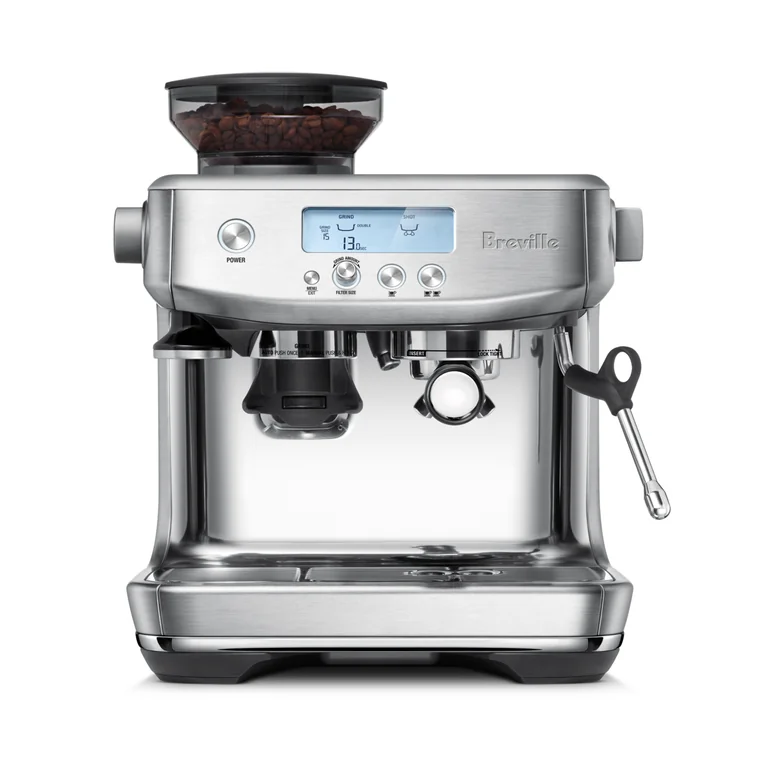
The Express with a faster brain. ThermoJet heats in about three seconds and the 30-setting grinder is a real step up, behind a cleaner LCD. Still a single boiler, so the question is whether the speed and finer grind are worth roughly $200 more.
Check price at Breville →- ThermoJet heats in about 3 seconds
- Finer 30-setting grinder
- Clean LCD interface
- Strong steam for the class
- All-in-one convenience
- Still a single boiler
- 54mm portafilter
- Around $200 more than the Express
- LCD over the Express gauge is a preference
I have pulled enough shots on the Barista Pro to know exactly what the extra money over the Express does and does not buy you. It is the same idea, an all-in-one semi-automatic with a grinder built in, but Breville swapped the heating system and sharpened the grinder. At around $900 it sits in an awkward but genuinely useful spot. Here is how it actually performs on the counter, not on the box.
How the Barista Pro actually pulls a shot
The headline change is the heating system. The Express uses a single ThermoCoil that takes a minute or so to come up to temperature. The Pro runs ThermoJet, which is ready in about 3 seconds. That sounds like a marketing line until you live with it. On a weekday morning you walk up, hit the button, and it is already at brew temperature by the time you have ground and tamped. No more standing around waiting for a light to settle. For anyone who hates fussing before their first cup, this is the single best reason to pick the Pro.
Once you are pulling, the shot quality is genuinely good. You get the same 54mm portafilter, the same 15-bar pump, and PID temperature control holding things steady. Dial in a fresh medium roast, aim for roughly 36 grams out in 25 to 30 seconds, and you can pull cafe-grade espresso with real crema. The Pro does not magically taste better than a well-dialed Express, because the brew group and basket size are the same. What you are paying for is speed and a finer grinder, not a different cup ceiling.
That 54mm basket comes with a real catch worth knowing before you buy. It is smaller than the 58mm commercial standard you find on a Gaggia Classic Pro or Breville Dual Boiler, so it holds a slightly smaller dose and accessory baskets are harder to track down. It works fine in daily use. But if you dream of bottomless portafilters and a deep aftermarket, the 54mm size will limit you. If you are still weighing portafilter size and basket type against everything else, our rundown of what actually matters when you shop a machine puts it in context.
The grinder, and why it matters more than the badge
The Pro's built-in conical burr grinder steps up to 30 grind settings, double the Express's 16. Grind is what decides whether your shot gushes or chokes, and more steps means you can land closer to the sweet spot instead of being stuck between too coarse and too fine. With a single-origin light roast, where the window is narrow, those extra settings earn their keep. With a forgiving medium-dark blend, you may never feel the difference.
People tend to skip past how much the grinder is doing here. On any machine without one, like the Gaggia or the Rancilio Silvia, you have to budget for a separate quality grinder, and a good one runs real money. Want to see how that math plays out before you commit? Our breakdown of the true cost of getting set up walks through the machine-plus-grinder total. The Pro folds a competent grinder into the box, which is the whole appeal of an all-in-one with a grinder. Is it as good as a standalone $400 grinder? No. But it is dialed for this machine and it gets you a clean, repeatable shot without a second appliance crowding your counter.
Before you spend, get your head around why one grind setting can turn a sour, fast shot into a balanced one. Read up on espresso grind size, because no amount of machine money substitutes for learning to read it.
Steaming milk and the single boiler tradeoff
Steam power on the Pro is good. The wand pushes enough pressure to build proper microfoam, and on milk drinks it gets you to a glossy, paint-like texture that pours decent latte art with practice. Heat-up to steam is faster than the Express, so the whole flat white routine feels quicker end to end.
The single boiler is where you pay for that simplicity, same as on the Express. The Pro brews or steams, never both at once. You pull your shot, the machine switches over and heats for steam, then you froth. For one or two drinks that pause is brief and barely noticed. Making four cappuccinos for guests is a different story, because the back and forth adds up and you will feel the wait.
This is the line that separates the Pro from a true cafe setup. A dual boiler machine runs brew and steam simultaneously, which is why it costs roughly $1,600 and why serious milk-drink households step up to it. Make several milk-heavy drinks at a time and the Pro will keep asking you to wait. Drink mostly straight espresso or one latte at a sitting, and the single boiler never gets in your way.
The LCD interface and the learning curve
The Pro swaps the Express's analog dials and pressure gauge for an LCD screen. It walks you through shot timing, grind amount, and temperature in a cleaner way, and the readout makes it easier to repeat a recipe once you find one you like. The screen is a convenience, though, not a revolution. Veterans sometimes miss the tactile pressure gauge on the Express because watching the needle teaches you to read your extraction. Beginners tend to prefer the LCD because it spells things out.
Either way, this is still a semi-automatic, which means you are the barista. You grind, dose, tamp, and time. Expect a real learning curve over the first week or two while you figure out how to read your shots and adjust grind. That is the whole point, and it is why a semi-automatic rewards you in a way a push-button machine cannot. Our guide on how to use an espresso machine covers the routine step by step if you have never done this. Does pulling shots by hand sound like a chore rather than a hobby? Then you are looking at the wrong category, and you should compare semi-automatic versus super-automatic before you spend.
Living with it: maintenance and reliability
Ownership is straightforward but not zero effort. You will wipe the steam wand after every milk drink, backflush the brew group regularly, and run a descale cycle when the machine prompts you, more often if your water is hard. The built-in grinder needs occasional cleaning too, since stale grounds and oils build up in the chute and throw off dosing. None of this is hard, but it is real, and skipping it is the fastest way to kill any espresso machine. Our descaling and maintenance guide lays out the schedule.
Reliability is generally solid for a consumer machine in this class. The ThermoJet system is fast and dependable, and Breville's parts and service network in the US is one of the better ones, which matters when something eventually needs a seal or a part. It is not a forever, rebuildable machine the way a heavy commercial-build unit is. Treat it as a very capable appliance that wants regular cleaning, and it will pull good coffee for years. If you want to see how I put machines through this kind of daily use before scoring them, our testing process spells out the method.
Barista Pro vs Barista Express: who should pay the extra
This is the decision almost everyone is really making. The cup ceiling is identical: both are 54mm, 15-bar, single-boiler, PID semi-automatics with a built-in grinder. What the Pro adds for the roughly $200 jump is the ThermoJet 3-second heat-up, a finer 30-setting grinder, and the LCD.
| Feature | Barista Express (BES870) | Barista Pro (BES878) |
|---|---|---|
| Price | Around $700 | Around $900 |
| Heating | ThermoCoil (about 1 minute) | ThermoJet (about 3 seconds) |
| Grind settings | 16 | 30 |
| Interface | Dials plus pressure gauge | LCD display |
| Portafilter | 54mm | 54mm |
| Boiler | Single | Single |
The Pro is the pick if you value a near-instant morning, drink lighter roasts where grind precision matters, or simply want the cleaner screen. The Barista Express saves you money and gives up almost nothing on cup quality, so it is the smarter buy on a budget or for anyone who actually enjoys watching a pressure gauge learn their shots. For a full side-by-side, see our Barista Express vs Barista Pro breakdown.
Who should skip both? Anyone who wants zero technique and one-touch lattes is better served by a super-automatic like the De'Longhi Magnifica Evo, which trades control for convenience. Crave cafe-level steaming and brewing at once plus a 58mm commercial portafilter, and you should step up to the prosumer tier. Brand new and price-sensitive buyers will find cheaper on-ramps in our best espresso machine for beginners roundup.
My verdict
The Barista Pro is the all-in-one I recommend to people who want their first proper espresso setup to feel fast and modern, and who are willing to learn to pull a shot by hand. It is not a quality upgrade over a dialed-in Express, it is a usability upgrade: instant heat, a finer grinder, a friendlier screen. That is worth roughly $200 to a lot of folks, and not to others.
Picture the buyer it fits best: someone who wants espresso in the first three minutes of the day, leans toward lighter roasts, and likes the idea of a screen coaching the recipe. If that is you, it is worth a look. You can check the current Barista Pro price and weigh it against the Express before you decide. One thing stays true no matter which you buy: fresh beans, a good grind, and a little practice will out-perform a pricier machine every single morning.
Check current pricing and any bundle deals from a trusted espresso retailer. Prices move with sales.
Affiliate link. We may earn a commission at no extra cost to you. It never changes our rankings (see how we test). We pull real shots before we recommend a machine.
Frequently asked questions
Is the Breville Barista Pro worth it over the Barista Express?
It depends on what you value. The Pro adds ThermoJet 3-second heat-up, a finer 30-setting grinder, and an LCD for about $200 more. The actual shot quality ceiling is the same since both use a 54mm portafilter and single boiler. Pay up for the speed and grind precision, or save and get the Express if a minute of warm-up does not bother you.
Does the Barista Pro have a built-in grinder?
Yes. It has an integrated conical burr grinder with 30 grind settings, double the Express's 16. That extra range helps you dial in lighter roasts more precisely. It is a competent grinder for an all-in-one, though it will not match a dedicated standalone grinder that costs several hundred dollars on its own.
Can the Barista Pro steam milk and brew at the same time?
No. The Pro is a single boiler, so it brews or steams, not both. After pulling your shot it switches over and heats for steam, then you froth. For one or two drinks the pause is brief. If you regularly make several milk drinks at once, a dual boiler machine is the better fit.
How long does the Barista Pro take to heat up?
About 3 seconds, thanks to its ThermoJet heating system. That is the main practical upgrade over the Barista Express, which uses a slower ThermoCoil that takes roughly a minute. By the time you have ground and tamped your dose, the Pro is already at brew temperature, which makes the morning routine noticeably quicker.
Is the Barista Pro good for a beginner?
Yes, with the right expectation. It is a semi-automatic, so you grind, dose, tamp, and time the shot yourself, which means a real learning curve in the first week or two. The LCD guidance and built-in grinder make it one of the friendlier ways to start. If you want pure push-button drinks, a super-automatic suits you better.

I pulled shots behind a bar for years and now obsess over home espresso. I own and tear down these machines and write every review and guide here. I rank by what makes good coffee, not by who pays the most. How we test →